
Why Great Campaigns Start Before You Need Them
A November event does not begin in November.
A holiday gifting campaign does not begin when the holiday season arrives. A fall conference does not begin when the registration deadline approaches. And a successful promotional product campaign certainly does not begin when someone in the marketing department sends an email saying:
“We need 500 branded items. Can we get them in three weeks?”
Yet this happens all the time.
Promotional products are often treated as a purchasing decision when they should be treated as part of the marketing strategy.
The difference matters.
The earlier a company begins planning, the more control it has over the product, design, customization, budget, and delivery. Waiting until a campaign becomes urgent doesn't necessarily make the project impossible.
It simply makes the number of choices smaller.
The Real Cost of Waiting
The biggest consequence of last-minute promotional planning isn't always price.
It is lost opportunity.
When a campaign is planned months in advance, marketers can explore a much wider range of products. They can compare price points, evaluate different materials and features, develop custom colors, consider packaging, and determine how the product fits into the larger campaign.
When the deadline is suddenly three weeks away, the conversation changes.
What's available?
What's in stock?
What's the fastest production option?
What can be shipped immediately?
Those are reasonable questions—but they are very different from:
What is the best product for our audience and our brand?
Planning early allows the second question to be answered first.
Promotional Products Are Marketing Assets
A promotional product should not be viewed simply as something that needs to arrive before an event.
It is a physical extension of a marketing campaign.
That means the same strategic questions used for other marketing assets should apply.
Who is receiving it?
What do we want them to remember?
How will they use it?
What does the product say about our company?
How does it fit our brand?
What is the experience when they open the package?
When these questions are answered before the product is ordered, the result can be significantly more intentional.
The product becomes part of the campaign instead of an item added to it.
Why 90 Days Creates Breathing Room
Ninety days isn't a magic number.
It is simply enough time to move through the process without forcing every decision into an emergency.
For a larger campaign, that extra time can make a meaningful difference.
It allows marketing teams to research products.
Creative teams can develop and revise artwork.
Procurement can compare options.
Stakeholders can approve the final design.
Suppliers can explore customization.
And production teams have time to execute the project properly.
Most importantly, the company still has options if the first idea doesn't work.
That's something a last-minute deadline rarely provides.
90 Days Out: Start With the Campaign
The first step shouldn't be choosing a product.
Start with the objective.
Is the campaign designed to generate leads?
Recognize employees?
Thank customers?
Support a product launch?
Build excitement around an event?
Create a holiday gifting experience?
The purpose determines the product.
A conference giveaway and an executive holiday gift may both carry the same company logo, but they shouldn't necessarily be the same promotional product.
The audience and the objective should drive the decision.
60–75 Days Out: Explore the Possibilities
Once the objective is clear, begin looking at products.
This is where early planning creates an advantage.
Instead of choosing from whatever happens to be available, marketers can explore different categories, materials, colors, features, and price levels.
For companies considering custom or overseas production, this is especially important.
More lead time can open the door to customization that may not be practical for an immediate-turn project.
That can include custom colors, product configurations, packaging, accessories, and other details that make a campaign feel distinctly branded.
The result can be a product that looks less like something pulled from a catalog and more like something created specifically for the campaign.
45–60 Days Out: Let Creative Do Its Job
One of the most overlooked parts of promotional product planning is creative development.
The product may be selected quickly, but the branding doesn't always deserve the same rush.
Creative teams need time to consider logo placement, artwork, colors, messaging, packaging, and overall presentation.
Then someone needs to approve it.
And sometimes the first version isn't the right version.
That is normal.
Good creative work often requires revision.
Giving the team time to make those changes can be the difference between a product that simply carries a logo and one that actually represents the brand.
30–45 Days Out: Finalize the Experience
At this point, the product and creative direction should be established.
Now the focus shifts toward execution.
Quantities are confirmed. Artwork is approved. Packaging is finalized. Accessories are coordinated. Production timelines are locked.
This is also the stage where marketers should look at the entire recipient experience.
What happens when the package arrives?
Is the product presented beautifully?
Is there a message included?
Does the packaging reinforce the campaign?
Could a customized accessory make the gift more useful?
These details may seem small individually.
Together, they create the experience.
And Then There Is QuickShip
Not every campaign gets 90 days.
Sometimes an opportunity appears unexpectedly. A client adds attendees to an event. A sales team needs gifts sooner than expected. An event date moves forward.
That's where domestic inventory and QuickShip programs become valuable.
Fast-turn inventory provides a different kind of flexibility: speed.
The important distinction is that QuickShip shouldn't always be viewed as the alternative to planning.
It can be the safety net within a broader promotional strategy.
Plan early when you can.
Move quickly when you need to.
A strong promotional supplier should be able to support both.
The Best Strategy Is Having Both Options
There is a tendency to think of domestic QuickShip and customized production as competing approaches.
They don't have to be.
They solve different problems.
QuickShip is about speed and certainty.
Custom production is about choice and differentiation.
When a campaign is planned early enough, marketers can determine which approach makes the most sense instead of being forced into whichever option happens to be available.
That flexibility is valuable.
A large holiday campaign might benefit from customized products, packaging, and accessories.
A last-minute sales meeting might require an in-stock QuickShip solution.
The best supplier relationship gives a marketing team access to both.
The Supplier Matters More Than the Product
There is another reason planning ahead matters: promotional marketing has become more sophisticated.
The supplier isn't simply responsible for shipping boxes.
A capable promotional partner should be able to help with product selection, inventory, customization, decoration, packaging, production, logistics, and deadlines.
That becomes particularly important when a campaign involves multiple moving parts.
The earlier the supplier is brought into the conversation, the more opportunities there are to solve problems before they become problems.
Instead of asking:
“Can you make this happen?”
the conversation becomes:
“How can we make this campaign better?”
That's a much more valuable relationship.
A Simple Rule for the Rest of the Year
If your campaign has a known date, work backward.
Don't start with the deadline.
Start with the experience you want to create and build the timeline from there.
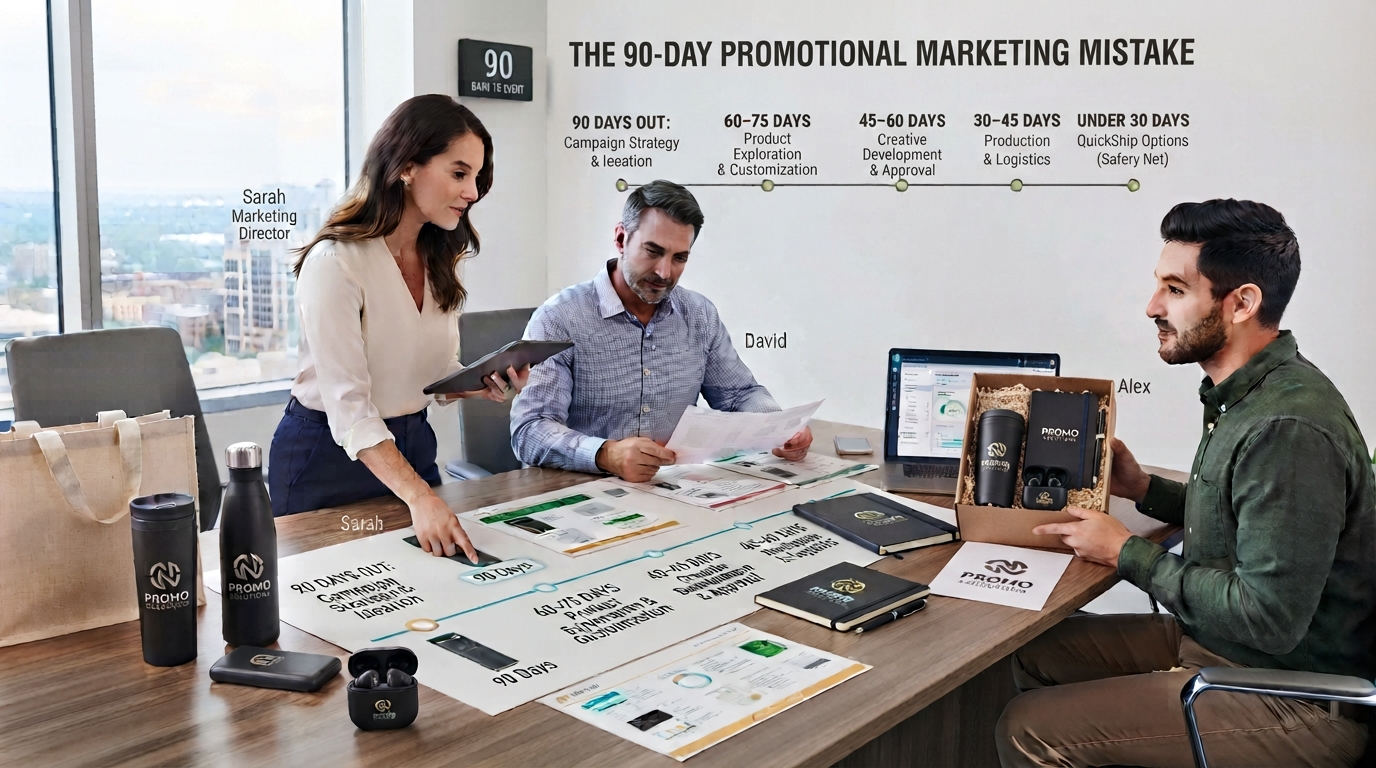
90 Days
Campaign objective, audience, budget, product exploration.
60–75 Days
Product selection, customization, creative development.
45–60 Days
Artwork approval, packaging, accessories, final specifications.
30–45 Days
Quantities, production, logistics, final confirmations.
Under 30 Days
QuickShip and in-stock solutions become increasingly important.
The exact timeline will vary depending on the product and level of customization.
But the principle remains the same:
The earlier you start, the more choices you have.
Don't Let the Deadline Choose Your Product
The most successful promotional campaigns aren't necessarily the ones with the largest budgets.
They're often the ones that had enough time to make thoughtful decisions.
The right product.
The right customization.
The right presentation.
The right recipient experience.
When marketers wait until the deadline is close, the deadline begins making those decisions for them.
When they plan early, they get to make the decisions themselves.
And that may be the most important reason to start your next promotional campaign 90 days before you need it.
Don't let the deadline choose your product.
Choose the product first.
Then give your marketing team the time to make it exceptional.
